WHITEBOARDIT THINKING · 003GTM COHERENCE · AUGUST 2026 · 7 MIN READA launch is not a campaign with a date attached.
A date can coordinate launch activity. It cannot create customer movement.
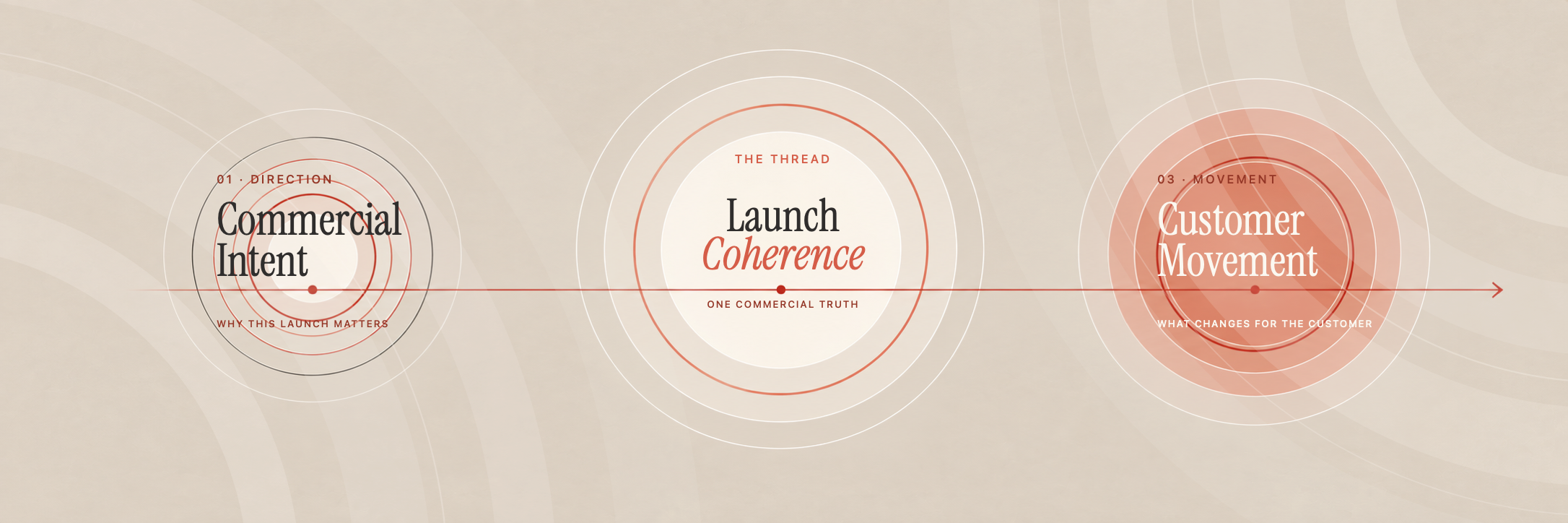
A launch creates movement when product decisions, customer understanding, commercial readiness and market activity work as one connected system.
BY SHARON WHITE
Some launches are beautifully organised but commercially underprepared.
The date is fixed. The campaign is planned. Content is moving through production. Sales has a presentation. The announcement is scheduled and everyone knows what must go live.
Yet beneath the activity, important questions remain unresolved.
Which customer change is this launch intended to create? Why should that change matter now? What must customers recognise or believe before they are ready to act? Can the organisation deliver the value being promised once attention arrives?
When those questions are unclear, the launch plan becomes a schedule of outputs rather than a system for creating movement.
Campaign activity may be part of a launch. It is not the launch itself.
01 · THE DATE
A date can organise activity. It cannot create coherence.
Launch dates are useful. They create urgency, coordinate teams and turn an open-ended ambition into a shared commitment.
They can also create the appearance of readiness.
As the date approaches, progress becomes visible through completed assets. The webpage is ready. The emails are approved. The presentation is finished. The event is booked. The campaign is built.
These are important signs of production. They do not necessarily show that the commercial thinking is resolved.
A launch can be operationally on time while the proposition remains weak. It can be visually consistent while product, marketing and sales are carrying different versions of the value. It can create attention before the organisation is ready to convert that attention into confident customer action.
The deadline does not cause these gaps. It exposes them.
A launch is therefore more than a coordinated publishing moment. It is a commercial transition: a deliberate attempt to change what customers recognise, understand, believe or do—and to prepare the organisation to support that change.
The date is a point in the plan. Coherence is what allows the plan to work.
02 · THE MOVEMENT
Begin with what needs to change.
Launch planning often begins with a list of activities.
What content do we need? Which channels will we use? When will sales be trained? What will happen on launch day?
A more useful starting point is:
What meaningful movement does the business need this launch to create?
The answer might be recognition in a new market, belief in a new proposition, commitment to a changed way of working, adoption of an existing capability or renewed confidence in the direction of the product.
Each requires a different launch.
If the business needs a new audience to recognise the relevance of the product, the launch must connect capability to a situation that audience already understands.
If customers understand the product but do not believe the proposed change is credible, the launch needs stronger evidence rather than greater volume.
If customers are willing to act but adoption is likely to be difficult, launch planning must extend into onboarding, enablement and value realisation.
Once the required movement is clear, the organisation can work backwards.
→ Who needs to move?
→ What must they recognise?
→ What must they understand or believe?
→ What would give them sufficient confidence to act?
→ What must be ready inside the organisation to support that action?
Only then should channels, assets and campaign mechanics take their proper place.
The activity follows the movement required. It does not define it.
03 · ONE COMMERCIAL THREAD
Different teams should not create different launches.
A launch moves through an organisation before it moves through a market.
Product understands what has changed in the technology. Leadership connects the launch to commercial ambition. Marketing creates recognition and demand. Sales carries the proposition into live customer situations. Customer success inherits the promise and helps turn it into realised value.
Each team sees a legitimate part of the launch.
The risk is that those parts never become a coherent whole.
Product may lead with capability. Marketing may build around a broader category story. Sales may focus on the objection most likely to slow a deal. Leadership may emphasise the growth opportunity. Customer success may be preparing for a very different practical reality.
The customer then encounters several versions of the same product: one in the campaign, another in the demonstration, another in the sales conversation and another after purchase.
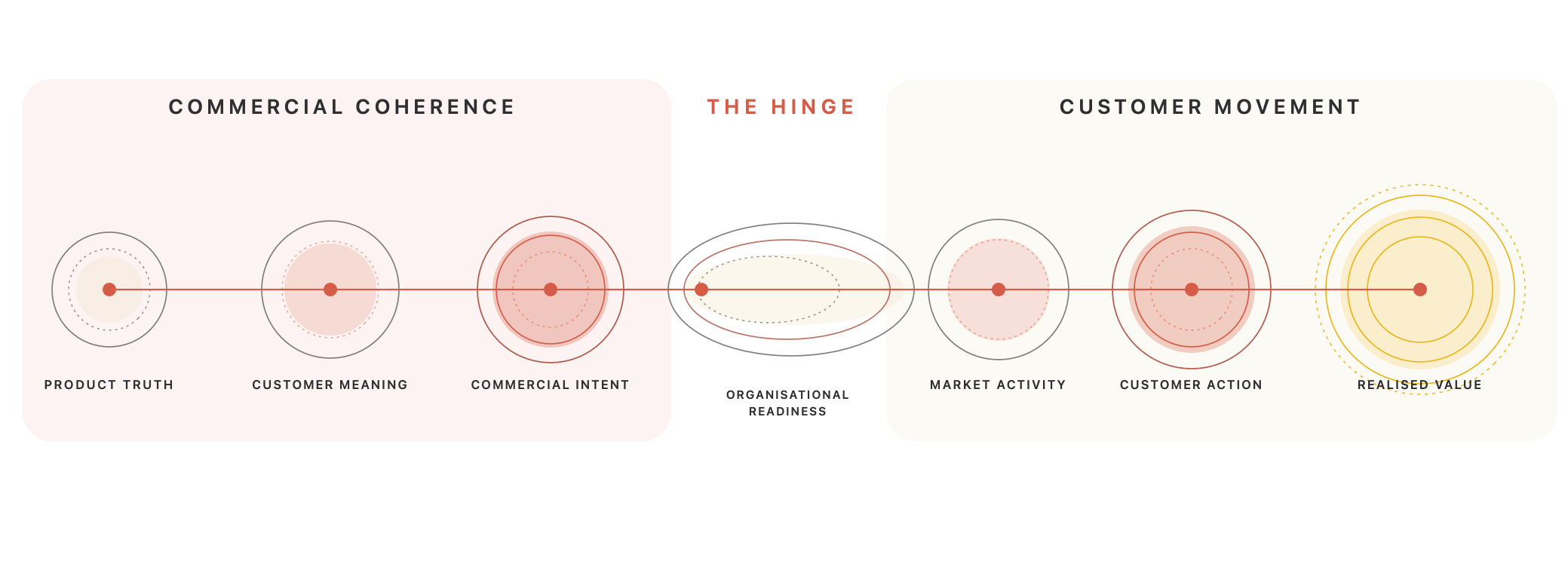
Go-to-Market Coherence does not require every team to repeat the same words. It requires every decision to remain connected to the same commercial thread:
Product truth
What has genuinely changed—and what does the product credibly make possible?
Customer meaning
Why does that change matter to a particular customer in a particular situation?
Commercial intent
What movement does the business need the launch to create?
Organisational ability
Can the business communicate, sell, deliver and reinforce the value it is promising?
When those conditions remain connected, teams can adapt the expression without changing the underlying truth.
Coherence is not rigid consistency. It is continuity of meaning.
04 · READINESS
Ready to release is not the same as ready to launch.
A product can be technically ready while the organisation remains commercially unready.
The capability works. The release has passed its checks. The roadmap commitment has been met.
But sales may not know which opportunities the product changes. Marketing may not have enough evidence to make the value credible. Customer success may not be prepared for the adoption conditions the proposition assumes. Leadership may expect a commercial result that the current route to market cannot reasonably create.
Launch readiness is sometimes treated as a final checklist completed shortly before the announcement. In reality, readiness is distributed across the customer experience.
Can the intended customer recognise why this matters?
Can the organisation explain the value without overstating the product?
Can sales connect the proposition to a live commercial situation?
Can the customer take a clear and proportionate next step?
Can the experience after that step support adoption and realised value?
A missing asset can usually be produced.
A missing condition is harder to repair under the pressure of a live launch.
This is why readiness should be examined before activity accelerates. The purpose is not to delay every launch until uncertainty disappears. It is to make important gaps visible early enough for the organisation to make conscious choices about them.
05 · AFTER THE ANNOUNCEMENT
Customers do not experience launch day.
Inside the business, launch day feels like a significant event. Work that has been building for weeks or months becomes public. Attention peaks and the organisation exhales.
Most customers experience something less dramatic.
They notice a message. Encounter a conversation. See a demonstration. Hear about the change from a colleague. Return later when a different pressure makes the product relevant.
Their movement does not follow the internal launch calendar.
This is why the announcement cannot be the end of the launch story.
A launch may create Choice Momentum by helping customers move from recognition towards belief, intent and action. But the value promised during that movement still has to survive implementation, adoption and use.
If the campaign creates expectations the product experience cannot support, coherence breaks after the sale.
If sales wins commitment around a use case that onboarding does not reinforce, the customer has to rebuild the meaning of the product after buying it.
If strong customer outcomes emerge but never return to the proposition, the launch fails to learn from the value it helped create.
A coherent launch connects the market story to the customer experience that follows.
The product becoming available is an important moment. The customer beginning to realise its value is the more important movement.
06 · THE EVIDENCE
Measure the change—not only the spike.
Launch reporting naturally focuses on the period surrounding the announcement.
Reach, traffic, engagement, leads, meetings, opportunities and revenue all provide useful information. But activity around a launch is not automatically evidence that the intended commercial movement occurred.
A spike in attention may show that the campaign was noticed.
It does not tell us whether the right customers recognised why the product mattered.
A high volume of demonstrations may indicate curiosity.
It does not tell us whether belief became strong enough to create meaningful commitment.
Early sales may show Choice Momentum.
They do not yet show whether adoption and realised value will follow.
The useful measurement question is not simply, “Did the launch perform?”
It is:
“What changed because of the launch—and what movement should happen next?”
That means looking for evidence across the commercial journey.
→ Did the intended audience recognise the proposition?
→ Did belief strengthen across the buying group?
→ Did customers invest meaningful time, access, budget or influence?
→ Did action lead to adoption?
→ Did adoption produce credible value?
→ What did the response reveal about the product, the customer or the original commercial assumptions?
A launch creates evidence as well as activity. That evidence should return to the organisation—sharpening the proposition, strengthening enablement, changing the adoption experience or revealing where the Commercial Translation remains incomplete.
The launch is not finished when the campaign ends.
It becomes commercially useful when the organisation can read the movement it created and act on what it learned.
A USEFUL PLACE TO BEGIN
Before adding another launch activity, ask whether every part of the launch is carrying the same commercial truth.
If the date is approaching but the customer change, organisational readiness or path to realised value remains unclear, the launch may need greater coherence—not a larger campaign.

CONTINUE EXPLORING