

THE WHITEBOARDIT PHILOSOPHY
The product is not the story. What it makes possible is.
Whiteboardit Thinking is a practical Product Marketing philosophy for turning product capability into customer meaning—and customer understanding into commercial movement.
It starts from a simple belief: before a business creates more marketing, it must understand the real commercial moment it is trying to move.

Start with the commercial moment—not the marketing task.
BEGIN BEFORE THE BRIEF
Businesses naturally describe what they can see: a messaging problem, a launch that is not landing, a campaign that needs strengthening, a sales team asking for more content or a Product Marketing role that needs filling.
But the visible request is not always the real requirement. Whiteboardit looks across the product, customer, market, business ambition and the dynamics between them before deciding what work will genuinely create movement.
The request is messaging.
The underlying issue may be weak positioning, an unclear proposition or several internal versions of what the product is for.
The request is a campaign.
The real problem may be that the campaign has no differentiated product meaning to amplify, so activity grows while relevance remains weak.
The request is a PMM hire.
The business may first need clarity about the mandate, seniority, outcomes, authority and organisational conditions the role requires.
THE ESSENTIAL PRODUCT MARKETING BRIDGE
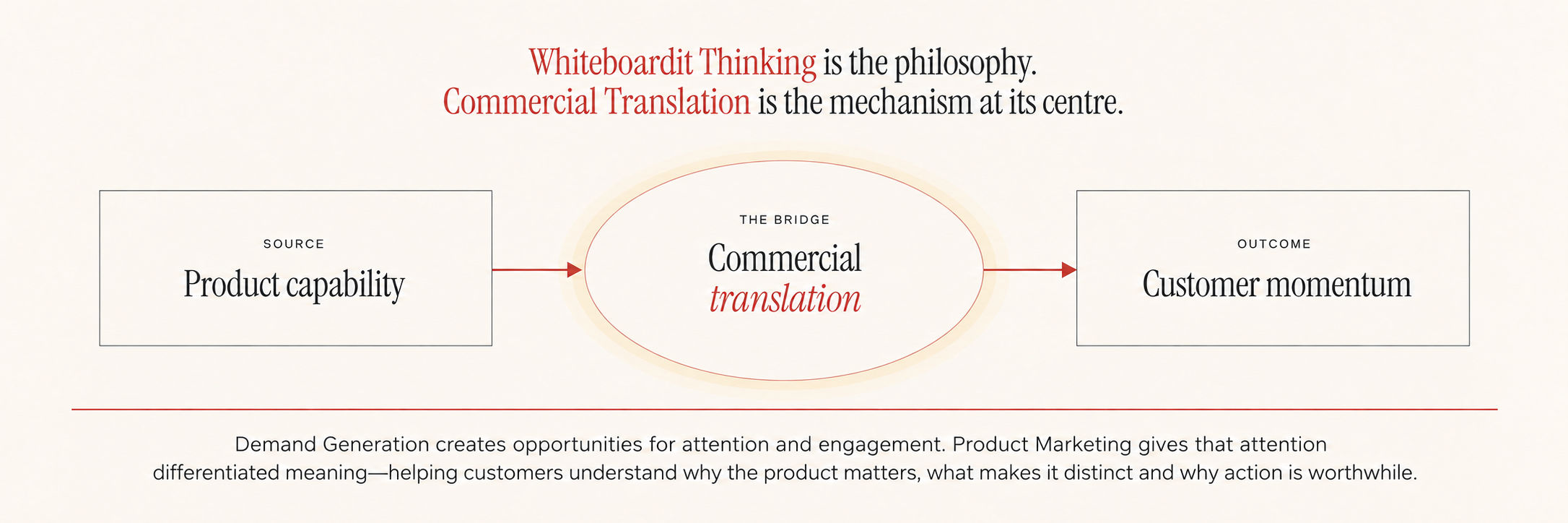
Product capability must cross a commercial bridge.
Complex products do not need to be simplified. They need to be made meaningful—without losing the depth or distinctiveness that makes them valuable.
A product can be technically impressive yet commercially invisible. Capability alone does not move customers. They move when they recognise what it changes in their world—and believe that change is relevant, credible and worth acting on.
Product Marketing creates that connection. Through Commercial Translation, it brings product truth together with customer reality, market context and business outcome—then turns that understanding into a clear commercial story the wider organisation can use with confidence and consistency.

BEYOND THE USE CASE
The most important moment is the moment of recognition.
A use case explains what someone can do with a product. A job to be done helps explain the progress they are trying to make. Both are important, but neither automatically creates commercial movement.
Movement begins when the customer recognises why the capability matters in their world: what becomes newly possible, what risk is removed, which constraint begins to shift, or what ambition moves within reach. This is the moment of recognition where product capability becomes personally and commercially meaningful.
Whiteboardit looks for that recognition point and builds the proposition, narrative, go-to-market direction and enablement around it.
What can the customer do?
What progress is the customer trying to make?
Why does this matter enough to understand, believe and act now?
A TWO-DIRECTION MECHANISM
Product Marketing must work in both directions.
Whiteboardit does not treat the market as the final destination of a one-way product story. Customer and market understanding must also travel back into product, commercial and business decision-making.
Product Market
Make capability meaningful.
Translate product truth into positioning, propositions, narratives and go-to-market direction that help customers understand why the product matters and help internal teams communicate it consistently.
Market Product
Bring customer reality back in.
Carry market signals, customer understanding, commercial friction and adoption insight back into the business so product and leadership decisions remain connected to the world they are intended to change.

FIVE PRINCIPLES OF WHITEBOARDIT THINKING
A disciplined way to find clarity without creating another strategy loop.
Whiteboardit Thinking makes room for exploration, challenge and ideas, but it is designed to create sufficient clarity for action. Deeper investigation follows where it creates value; it does not become a substitute for action.
-
Begin with truth, not output.
Understand what is actually happening before prescribing messaging, content, campaigns, frameworks or resources. The quality of the answer depends on the quality of the question.
-
Make complexity visible.
Bring the different product, market, customer and organisational perspectives into one working view. Visibility exposes assumptions, contradictions, missing evidence and dependencies that isolated teams cannot see.
-
Find the commercial thread.
Separate symptoms from causes and identify the important truth that must carry through the proposition, narrative, launch, enablement, adoption work and internal decision-making.
-
Translate for recognition.
Connect capability with the moment customers recognise what it makes possible. Translation is successful when technical truth becomes customer meaning without losing its commercial distinctiveness.
-
Create movement and leave capability.
Turn understanding into decisions, priorities and usable working tools. The engagement should not only deliver an answer; it should strengthen the organisation’s ability to think and act after Whiteboardit leaves.
WHAT CLARITY CHANGES
Shared understanding becomes confident action.
Decisions sharpen.
Leadership can distinguish the important commercial choice from the volume of possible marketing activity.
Teams align.
Product, marketing, sales and leadership work from a shared understanding of the customer and the product’s role.
Execution connects.
Positioning, campaigns, enablement, launches and adoption work carry the same commercial thread rather than creating competing stories.
Customers move.
Commercial movement is rarely one dramatic moment. It develops through recognition, confidence, action, learning, adoption and proof.
PRODUCT MARKETING IN AN AI-ENABLED WORLD

AI expands possibility. It does not replace judgement.
AI can accelerate research, synthesis, production and iteration, expanding what Product Marketing teams can achieve. But greater output also creates more options, noise and expectation. Judgement is still required to decide what matters, resolve competing perspectives and take responsibility for the direction chosen.
Whiteboardit uses AI to extend experienced Product Marketing thinking—not to substitute faster production for leadership, context or commercial judgement.

A PHILOSOPHY DESIGNED TO BE USED
Whiteboardit Thinking is a working model—not a statement on a wall.
The philosophy creates a consistent way to approach Product Marketing challenges while remaining flexible enough to meet the business where it is. It can be applied through services, tools, workshops and learning.
Strategic work
Use the model to diagnose commercial moments, guide positioning and proposition work, shape go-to-market decisions and create the tools teams need to act.
Leadership
Use it to clarify the role of Product Marketing, establish priorities, strengthen cross-functional influence and define the capability the business genuinely needs.
Workshops
Use the shared structure to bring different perspectives into the same room, make assumptions visible and reach decisions without allowing discussion to become endless.
Learning
Use the principles, models and practical tools to develop Product Marketers and business leaders through courses, programmes and applied learning materials.
WHAT WHITEBOARDIT IS
A practical discipline for commercial clarity.
WHAT WHITEBOARDIT IS NOT
More activity disguised as strategy.

BRING THE COMMERCIAL MOMENT
Clarity begins with the right question.
You do not need to arrive with a finished brief or know which service you need. Bring the product, customer, market or organisational moment that needs to move. We will begin by understanding what is really happening.