WHITEBOARDIT THINKING · ISSUE 005
PMM LEADERSHIP & CAPABILITY · SEPT 2026
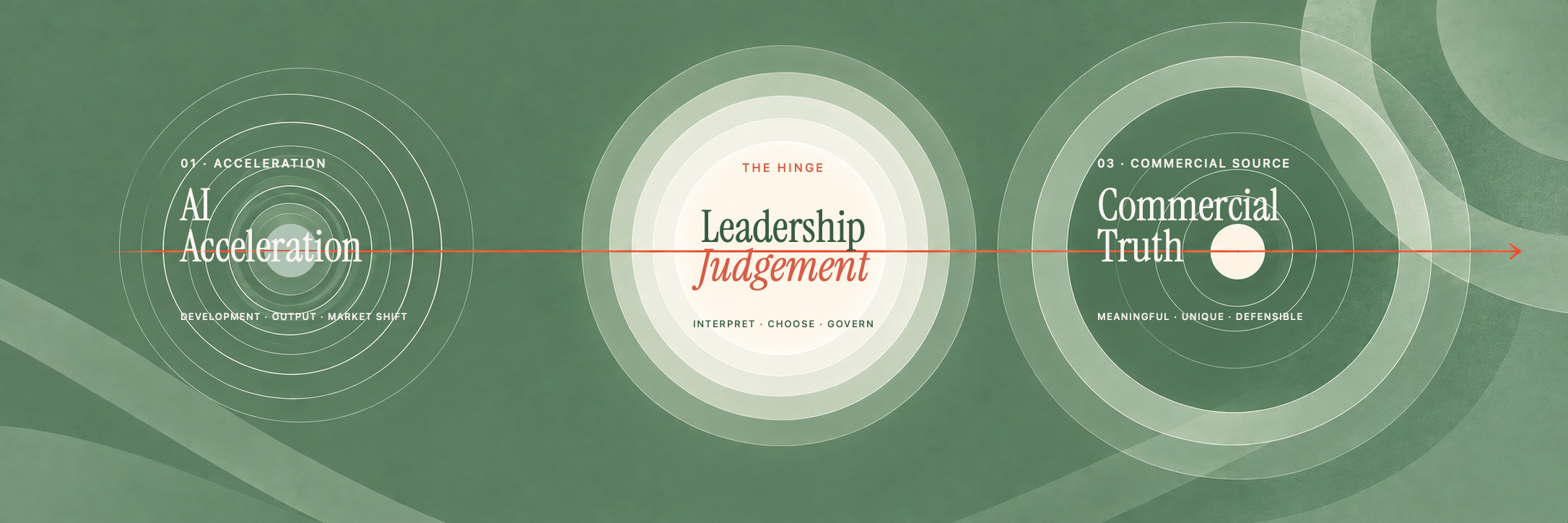
AI is accelerating the market. Who is protecting the commercial truth?
When output becomes easier to create, the quality of its commercial source becomes more—not less—important.
AI can compress production, development and decision cycles. But without experienced Product Marketing leadership governing the commercial source, faster output can amplify generic thinking, stale assumptions and undifferentiated claims.
BY SHARON WHITE · 9 MIN READ
AI has made it possible to produce more, in more formats, in considerably less time.
Messaging drafts, presentations, sales materials, competitive summaries and launch content can all be created with a speed that would have been difficult to imagine only a few years ago.
That is genuinely valuable.
But the most significant change is not happening only within the visible outputs of Product Marketing.
AI is accelerating the whole commercial system around them.
Product teams can develop and release more quickly. Competitors can respond faster. Market language can converge almost overnight. Customer expectations shift as new capabilities become familiar. More propositions, messages and launches need to be interpreted, tested and refreshed.
The commercial clock is speeding up.
I began thinking more deeply about this after reading an article by Abid Chaudhry for the Product Marketing Alliance.
Abid describes the proprietary organisational context that AI should draw from as the “source canon”: the accumulated product reasoning, customer evidence and internal knowledge that competitors cannot access.
He also connects the quality of this source to Product Marketing Alliance’s established framework of Meaningfulness, Uniqueness and Defensibility.
His argument crystallised something I had been seeing from a different but connected perspective.
The risk is not simply that AI may replace some of the visible production associated with Product Marketing.
It is that organisations may remove experienced Product Marketing leadership at precisely the moment AI is increasing the volume, velocity and commercial consequences of what they produce.
If that leadership disappears, the organisation may not simply lose the person producing the output.
It may lose the person responsible for determining what the output should be grounded in—and whether it deserves to be produced at all.
The question is no longer simply how effectively an organisation can use AI.
It is whether the organisation has a sufficiently strong commercial source for AI to use—and the experienced leadership required to keep that source meaningful, unique and defensible.
01 · THE VISIBLE SHIFT
AI has changed the economics of output.
Much of the work associated with Product Marketing is highly visible.
Positioning documents. Messaging frameworks. Launch plans. Sales enablement. Competitive materials. Customer presentations.
These are tangible outputs, and AI can already help create many of them faster.
If Product Marketing is understood primarily through these artefacts, it is easy to see why the function might appear increasingly replaceable.
But the artefact is the endpoint of the work—not its full value.
Before a credible message can be written, somebody must determine what matters.
Before a proposition can be expressed, somebody must understand the product truth, the customer tension, the competitive context and the evidence connecting them.
Choices must be made about what to emphasise, what to leave behind and what the organisation can credibly claim.
AI can identify patterns, synthesise material and assemble language.
It cannot independently determine whether a pattern deserves to become the organisation’s commercial position.
That judgement happens upstream of the output.
When the visible artefacts are separated from the thinking that created them, Product Marketing can appear to be a production function.
When the upstream work is understood, its strategic value becomes much clearer.
AI can accelerate what a business says. Product Marketing leadership determines whether it is worth saying.
02 · THE ACCELERATING SYSTEM
AI is not only changing marketing production.
The impact of AI extends far beyond creating content.
It is enabling product and engineering teams to explore, build and release more quickly. It is shortening the distance between an idea and a customer-facing capability. It is allowing competitors to respond faster and new entrants to appear with fewer traditional barriers.
More development creates more releases.
More releases create more decisions about relevance, positioning, adoption and value.
At the same time, customers are adjusting their expectations. Market categories are shifting. Familiar claims are being repeated by multiple businesses using similar models, sources and language.
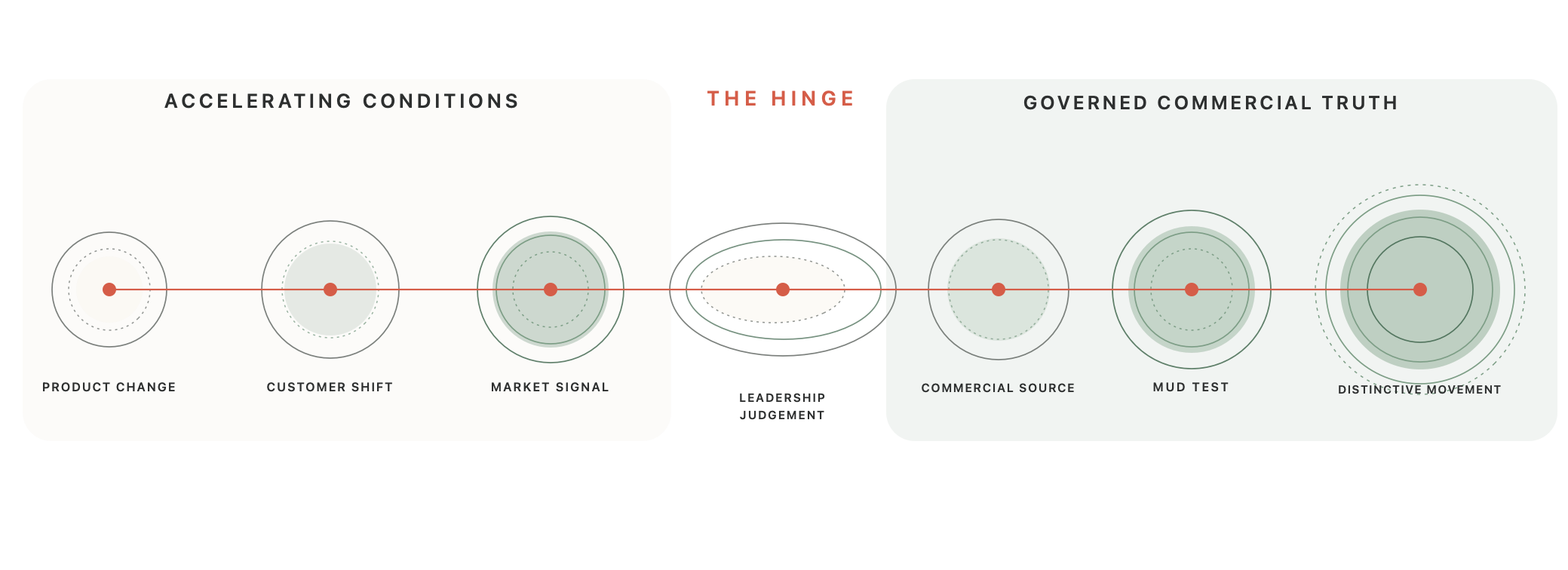
Each of these changes can create a new Commercial Moment: a point at which movement in the product, customer, market or organisation requires a commercial decision.
When these moments occur more frequently, the need for interpretation does not disappear.
It increases.
Reducing senior Product Marketing judgement while increasing the velocity of the system risks creating an organisation capable of producing more—but less able to determine what should matter commercially.
The consequences also travel faster.
An unsupported proposition can be distributed across campaigns, sales materials and AI-enabled customer interactions within hours. An untested assumption can be repeated so consistently that it begins to look like established truth. A superficial point of difference can spread across the organisation before anybody has established whether customers value it.
Speed increases capacity. It does not automatically create coherence.
03 · THE COMMERCIAL SOURCE
The output can only be as distinctive as the truth it draws from.
Every organisation using AI is drawing from a source.
That source may be deliberate, proprietary and well governed.
Or it may be a mixture of public information, inherited documents, outdated messaging and untested internal assumptions.
The difference matters.
Building on Abid’s source-canon framing, I think of the commercial source as the evolving body of evidence, knowledge and decisions from which an organisation’s commercial expression is formed.
It includes:
the product truth and the reasoning behind important product choices;
direct customer evidence, needs and tensions;
market and competitive context;
the commercial choices the organisation has made;
proof of the value it can credibly deliver;
the boundaries of what it should—and should not—claim;
the language that accurately connects its capability to customer meaning.
This is not simply a collection of approved copy.
Nor is it a folder containing previous messaging documents, presentations and brand guidelines.
Those are outputs from the source.
The commercial source sits beneath them. It explains why the organisation believes what it believes, which evidence supports that belief and which choices have shaped the position it takes to market.
Without this foundation, AI may produce fluent output while drawing from fragmented, contradictory or generic inputs.
The problem will not necessarily be visible in the quality of the writing.
The material may look polished, confident and complete.
The weakness will appear in what the writing cannot establish: why the proposition matters, why it belongs to this organisation and why a customer should believe it.
04 · THE WORK BEFORE THE WORDS
The visible language should be the consequence of deeper choices.
When I developed Whiteboardit’s methodology through Project Alpha, the final pages and language were not the starting point.
The work began by establishing what Whiteboardit is, why it exists, what experience and perspective sit behind it, and what it can bring that is genuinely distinctive.
It required questions that could not be answered by generating more copy.
What is the problem Whiteboardit exists to address?
What have I repeatedly observed in organisations attempting to move strong products into the market?
Which parts of my experience have shaped a distinctive point of view?
What does Whiteboardit understand that customers may recognise from experience but have not yet been able to articulate?
Which ideas are central to the methodology—and which are simply familiar Product Marketing language?
The final output became more coherent because its source had been made explicit.
AI could help explore, structure, challenge and express that thinking. It could accelerate the work once the underlying truth began to emerge.
It could not determine Whiteboardit’s identity, experience or commercial meaning on its behalf.
That understanding had to come first.
The same distinction is increasingly visible in AI products themselves.
Adding a general generative capability to a product may create convenience, but it does not necessarily create durable differentiation.
A company that has accumulated decades of proprietary information—and has carefully structured that information to support predictive or agentic AI—possesses a fundamentally different asset.
Its advantage is not simply that AI has been added to the product.
The value resides in the uniqueness, relevance and structure of the underlying data—and in the expertise used to interpret and apply it.
The same principle applies to the commercial output surrounding the product.
The model may accelerate the expression. The source creates the potential for differentiation.
05 · THE DIFFERENTIATION TEST
Speed does not protect Meaningfulness, Uniqueness or Defensibility.
AI can make an argument sound confident.
It cannot, by itself, establish whether that argument is meaningful to the customer, unique within the market or defensible by the organisation.
These are different tests.
Meaningfulness requires a grounded understanding of the customer, the situation they are navigating and the problem that matters to them.
Uniqueness requires knowledge of the competitive environment and the discipline to distinguish genuine difference from familiar category language.
Defensibility requires evidence that the difference is rooted in something competitors cannot easily reproduce: proprietary data, accumulated expertise, capability, methodology, customer insight, ecosystem or experience.
The more organisations use similar models and publicly available sources, the greater the risk of polished commercial convergence.
The language may be fluent.
The presentation may be convincing.
The output may still be commercially indistinguishable.
AI can suggest that a proposition is unique because it has been instructed to express difference. It cannot make that difference true.
It can articulate a benefit without establishing whether the benefit matters sufficiently to influence customer choice.
It can repeat a proof point without determining whether that proof demonstrates something competitors cannot match.
These are commercial judgements.
Experienced Product Marketing leadership tests the output against the MUD elements.
It challenges unsupported difference. It connects claims to evidence. It distinguishes a valuable product capability from a fashionable feature. It determines where the organisation has earned the right to make a stronger commercial claim—and where the claim needs to be narrowed.
Without that control, AI can create more polished expressions of less distinctive ideas.
06 · THE COMMERCIAL MOMENT
The commercial source must move with the market.
A commercial source cannot be created once and treated as a permanent library of truth.
Products change. Customer priorities move. Competitors respond. Evidence develops. Capabilities that once appeared distinctive can become expected features of the category.
The source must evolve with them.
This is where the Commercial Moment becomes important.
A Commercial Moment occurs when a change in the product, customer, market or organisation creates the need to reconsider what the business should communicate, prioritise or do.
Recognising that moment requires more than monitoring information.
It requires judgement.
What has materially changed?
Does the change alter the value customers can realise?
Does it strengthen or weaken the existing proposition?
Is the organisation facing a messaging adjustment, a product decision or a more fundamental shift in commercial direction?
Does new evidence reinforce the current position—or expose an assumption that is no longer safe?
AI may help detect signals and synthesise large quantities of information.
But somebody must interpret whether those signals represent a meaningful change and decide what the organisation should do in response.
That is not simply an information-management responsibility. It is a commercial leadership responsibility.
A USEFUL PLACE TO BEGIN
Before expanding the volume of AI-generated commercial output, put five headings on the whiteboard:
THE COMMERCIAL MOMENT
What has changed in the product, customer, market or organisation—and what decision does that change require?
THE PRODUCT TRUTH
What can the product genuinely make possible, and what evidence supports it?
THE CUSTOMER REALITY
What does the customer need to recognise, believe, attempt or experience before value can move?
THE MUD TEST
Which parts of the proposition are genuinely meaningful, unique and defensible?
THE SOURCE OWNER
Who has the judgement, authority and responsibility to maintain this truth as conditions change?
Then examine the material currently feeding your AI systems.
→ Is it grounded in evidence or inherited assertion?
→ Does it reflect today’s market or yesterday’s messaging?
→ Does it contain the reasoning behind important decisions—or only the final words?
→ Does it explain what makes the organisation distinctive—or simply give the model more language to rearrange?
→ Is somebody accountable for challenging and updating it?
AI can make commercial output faster. The quality of the movement it creates will still depend on the quality of the commercial truth behind it.
07 · COMMERCIAL TRANSLATION
The source becomes valuable when it informs movement.
Maintaining the commercial source is not an exercise in preserving institutional knowledge for its own sake.
Its value lies in what it enables the organisation to understand and do.
Commercial Translation turns product capability into customer meaning. It connects what the organisation has built with what customers can recognise, believe and act upon.
It also works in the opposite direction.
Customer and market reality must be translated back into the organisation so that product, commercial and strategic decisions are better informed.
This two-way movement keeps the commercial source alive.
New product capability adds to the source—but only after its customer and commercial implications have been interpreted.
Customer evidence adds to the source—but only after the organisation understands what that evidence means for its decisions.
Market movement adds to the source—but only after somebody has distinguished a durable shift from temporary noise.
Without Commercial Translation, the commercial source risks becoming a repository.
With it, the source becomes an active decision system.
It helps the organisation maintain coherence as more people and tools create output. It provides a common foundation without forcing every customer, proposition or commercial moment into the same language.
AI can then operate from a stronger base.
It can adapt established truth without inventing it. It can accelerate expression without separating that expression from the evidence and decisions beneath it.
08 · THE LEADERSHIP REQUIREMENT
AI increases capacity. It also raises the value of experienced judgement.
None of this is an argument against using AI.
AI can help organisations gather signals, identify themes, synthesise evidence, create first drafts and adapt established thinking across multiple formats.
Used well, it can release Product Marketing from a significant amount of repetitive production.
But releasing time from production is not the same as removing the need for leadership.
Somebody must establish what belongs in the commercial source.
Somebody must identify contradictions between what the product does, what the company says and what customers experience.
Somebody must determine which evidence is current, which conclusions remain valid and which assumptions have quietly become embedded in the organisation’s language.
Somebody must decide when a claim lacks proof, when a genuine point of difference is being diluted by generic language and when the Commercial Moment has changed.
These responsibilities require seniority not because every decision must become hierarchical, but because commercial choices cut across product, marketing, sales, customer success and executive priorities.
They require experience, organisational influence and the authority to challenge convenient assumptions.
They also require a willingness to make choices.
AI can present multiple plausible answers. Commercial leadership must determine which answer the organisation is prepared to stand behind.
When AI accelerates the organisation, these decisions arrive more frequently and travel further.
Removing experienced Product Marketing leadership may reduce visible cost or preserve output volume in the short term.
But it can also leave the organisation producing more material from a source that nobody is actively testing, governing or translating.
The risk is not that the output will look poor.
The risk is that it will look perfectly credible while saying nothing distinctive.
ACKNOWLEDGEMENT
This Insight was prompted by ServiceNow’s Senior Product Marketing Director, Abid Chaudhry’s article for the Product Marketing Alliance on the role of Product Marketing in owning an organisation’s “source canon”.
His connection between proprietary organisational context, AI output and Product Marketing Alliance’s established framework of Meaningfulness, Uniqueness and Defensibility helped crystallise the starting point for this article.
This Insight builds from that foundation to explore a connected Whiteboardit proposition: as AI accelerates product development, market movement and commercial output, experienced Product Marketing leadership becomes increasingly important in recognising the Commercial Moment, governing the commercial source and putting Commercial Translation into practice.

CONTINUE EXPLORING