WHITEBOARDIT THINKING · 004PMM LEADERSHIP & CAPABILITY · SEPTEMBER 2026 · 8 MIN READDo you need a Product Marketing hire—or Product Marketing leadership?
A new role can add capacity. It cannot, by itself, create the mandate, authority or judgement the organisation is missing.
The visible request may be headcount. The underlying need may be direction, decision-making or senior cross-functional influence.

BY SHARON WHITE
A business rarely begins by saying it has a Product Marketing mandate problem.
It feels the symptoms first.
Launches are busy, but the product story remains unclear. Sales wants stronger enablement. Marketing needs sharper messaging. Product wants customers to understand what has been built. Leadership sees a gap between product potential and commercial momentum.
The understandable response is to hire someone.
A job description is created. Responsibilities accumulate. Positioning, messaging, launches, research, enablement, competitive intelligence, content and sales support are gathered into one role.
The vacancy becomes visible before the underlying requirement has been fully defined.
Sometimes a permanent Product Marketing hire is exactly what the business needs. But hiring becomes risky when the new role is expected to resolve an ambiguity the organisation has not yet addressed.
Before deciding who to hire, it is worth asking what kind of Product Marketing responsibility the business actually needs someone to hold.
01 · THE REQUEST
Headcount is a visible answer to an often less visible problem.
Hiring creates something concrete.
It gives the requirement a title, a budget, a reporting line and a recruitment process. It creates the reassurance that someone will soon own the work.
But the work is not always the problem.
The deeper issue may be that the organisation has not agreed what Product Marketing is there to change.
One leader may expect positioning and market strategy. Another may expect campaign content. Product may want launch support. Sales may want collateral. Marketing may want a stronger narrative. The executive team may want commercial clarity without having decided who has the authority to create it.
All of those expectations arrive in the same job description.
The result can look comprehensive while remaining fundamentally unclear.
A list of deliverables describes activity. It does not define the commercial responsibility behind them.
The first question is therefore not simply whether the business has enough Product Marketing capacity.
It is whether anyone is providing the direction that makes that capacity commercially useful.
xxx
02 · THE DISTINCTION
Capacity and leadership solve different problems.
A Product Marketing hire can add ownership, continuity and execution capacity.
That may be the precise requirement. The business may already have a clear strategy, an established mandate, strong leadership and an operating model into which another capable person can contribute.
Product Marketing leadership addresses a different need.
It determines what matters, where the commercial problem really sits and which decisions must be made before more activity is added. It connects product, customer, market and organisational perspectives. It creates a coherent direction and protects it when functional priorities begin to pull apart.
Leadership does not necessarily mean managing a large team.
It means accepting responsibility for judgement.
What should Product Marketing own? What should it influence? Which customer and market truths should shape the business? Which requests should be challenged? Which trade-offs must be made? What evidence should change the direction?
A sufficiently senior permanent hire may provide that leadership.
But only if the role has the mandate, access and authority to do so.
A leadership requirement cannot be solved merely by increasing the volume of Product Marketing output.
03 · THE MANDATE
Define the need before the resource.
A mandate explains why the function exists in this business, at this moment.
It is more specific than a generic description of Product Marketing. It connects the role to the commercial change the organisation needs to make.
The mandate might be to establish a differentiated position in a changing market. It might be to connect a complex product portfolio to clearer customer value. It might be to bring coherence to launches, equip sales with a more credible commercial story or create the customer understanding required for adoption.
Those are different requirements.
They involve different decisions, relationships, experience and levels of organisational influence.
A useful mandate should make four things visible:
What commercial movement is the business trying to create?
What responsibility should Product Marketing hold within that movement?
Which decisions must the role be able to make or influence?
What evidence will show that the function is creating value?
Without this clarity, ambiguity is transferred to the person who is hired.
A junior Product Marketer can become overloaded with expectations they do not have the authority or experience to resolve. A senior Product Marketing leader can inherit a large activity backlog while being given too little scope to change its direction.
Both situations can later be described as performance problems.
The original problem may have been role design.
04 · THE LEVEL
Seniority should follow the decisions the role must make.
Product Marketing seniority is often judged through years of experience, previous titles or the size of programmes someone has managed.
Those signals are useful, but they do not define the level the business needs.
The better indicator is the nature of the decisions the role must hold.
Does the business need someone to work within an established direction—or establish the direction?
Will they execute positioning—or resolve competing views about what the business should stand for?
Will they support launches—or decide what needs to change for customers, sales and the organisation before launch activity begins?
Will they respond to executive requests—or challenge the assumptions beneath them?
These are not simply differences in workload. They are differences in judgement, accountability and influence.
Tools and AI can increase the capacity of a capable Product Marketer. They can accelerate research, synthesis, drafting and production.
They cannot supply organisational authority, pattern recognition or the experience required to challenge a leadership team at the right moment.
A junior hire plus greater production capacity is not automatically equivalent to Product Marketing leadership.
Equally, a senior title cannot compensate for a role that has been designed without meaningful authority.
05 · THE CONDITIONS
Even the right person can be placed into the wrong system.
A strong appointment matters. So do the conditions surrounding it.
Product Marketing operates between functions. It depends on access to product decisions, customer evidence, market context, commercial priorities and the people responsible for taking propositions to market.
That position gives the function value. It also makes the function vulnerable when its relationships and decision rights are unclear.
A Product Marketing leader needs more than a collection of stakeholders.
They need an executive sponsor who understands the function’s purpose. They need access to customers and product thinking. They need the ability to bring conflicting perspectives into the same conversation. They need clarity about where Product Marketing decides, where it recommends and where it supports.
Without those conditions, the function can quickly become a service desk for downstream requests.
Messaging is requested after the product decision. Enablement is requested after the commercial story has fragmented. Launch support is requested after the date has been set. Content is requested before the customer meaning has been agreed.
The Product Marketer remains busy, but the commercial questions that should shape the work remain elsewhere.
When this happens, adding more capacity may help the organisation process more requests.
It may not improve the decisions creating those requests.
06 · THE MODEL
Permanent headcount is one route to capability.
A permanent hire is a strong decision when the mandate is clear, the role has appropriate authority and the organisation has an enduring need for the capability.
The work has continuity. The reporting relationship makes sense. The required level is understood. The person will enter a system that is prepared to use their expertise.
But permanent headcount is not the only way to access Product Marketing capability.
Sometimes the immediate need is to define the mandate, establish the direction or create the operating model before recruiting into it.
Sometimes a business needs senior Product Marketing judgement during a high-stakes product, positioning, launch or market moment, but is not yet ready for a permanent leader.
Sometimes an existing team needs experienced leadership and greater coherence rather than another individual contributor.
Fractional leadership, an interim model or a focused strategic engagement can help the organisation make those decisions first. It can clarify what the permanent requirement should become rather than acting as an automatic substitute for it.
The operating model should follow the commercial need.
Not every capacity gap is a leadership gap. Not every leadership gap requires immediate permanent headcount.
The important thing is to know which problem the business is solving.
A USEFUL PLACE TO BEGIN
Before writing the job description, put five headings on a whiteboard:
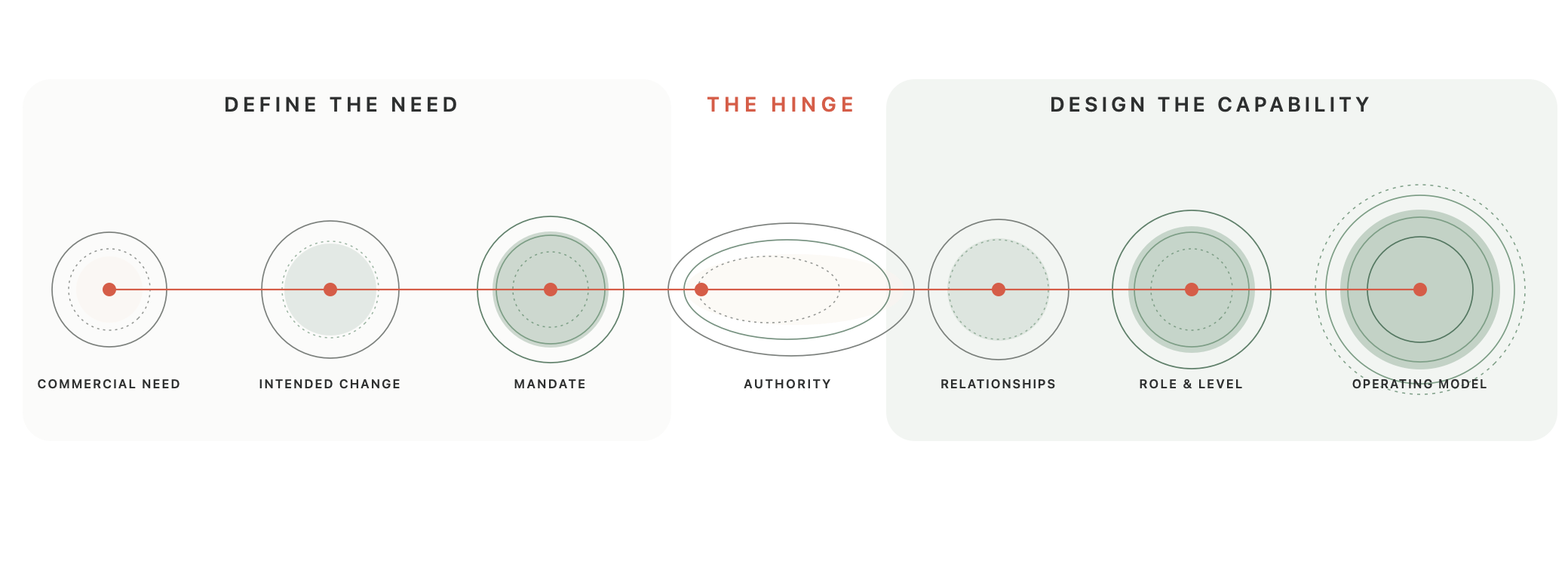
→ Commercial need. → Intended change. → Mandate. → Authority. → Operating model.
Ask what the business needs Product Marketing to change, which decisions that requires, which relationships make those decisions possible and what level of judgement the responsibility demands.
If those answers are clear, the right role becomes much easier to see. If they are not, the business may need Product Marketing leadership before it needs another Product Marketing hire.

CONTINUE EXPLORING