WHITEBOARDIT THINKING · 002
SEPTEMBER 2026 · 8 MIN READ
Understanding is not the same as momentum.
A customer can understand your product but still not give buying signals.
Understanding matters. But commercial movement depends on what happens next: whether customers believe, commit, act and continue towards realised value.
BY SHARON WHITE
Some customers understand a product perfectly well and still decide not to move.
They follow the demonstration. They recognise the use case. They can repeat the proposition and may agree that the product is capable. Yet the commercial response remains cautious, fragmented or still.
When that happens, businesses often reach for more explanation: more content, more education, another proof point or a longer nurture sequence. Sometimes those things help. But they cannot resolve a problem that no longer sits in understanding.
I think of Customer Momentum as the meaningful forward movement created when customers progress from recognising a product’s relevance to acting on its value—and continue through adoption, realised value and renewed opportunity.
Understanding contributes to that movement. It is not the movement itself.
01 · THE LIMIT OF UNDERSTANDING
Clear does not automatically mean compelling.
Inside a business, understanding can feel like an important finish line. The message landed. The demonstration made sense. The customer followed the logic. People engaged with the content or responded positively in the room.
The customer is making a different assessment. They are deciding whether the change matters enough, whether the promise is credible, whether other people will support it and whether acting feels more worthwhile than remaining where they are.
A proposition can therefore be clear without being sufficiently relevant. It can be relevant without being believable. It can be believable without creating enough confidence to act.
Understanding tells us that the customer can make sense of the product. Momentum tells us that something meaningful is changing in their relationship with it.
Clarity makes movement possible. It does not make movement inevitable.
02 · CHOICE MOMENTUM
Movement begins before the customer acts.
Customers rarely move from first contact to confident action in one step. They progress through a series of connected changes:
Recognition
I can see how this relates to a situation, pressure or ambition in my world.
Understanding
I can make sense of the product, the change it enables and what that change would involve.
Belief
I consider the promised value credible, relevant and possible for an organisation like mine.
Intent
I am prepared to invest something in pursuing the opportunity.
Action
I make a meaningful commitment that allows the value to be explored or realised.
I describe this movement towards customer commitment as Choice Momentum.
In a complex B2B decision, the movement is rarely neat or evenly shared. A technical buyer may understand the product while an executive sponsor remains unconvinced of the priority. A user may believe in the value while procurement sees only risk. One internal champion may be ready to act while the wider buying group is still trying to recognise why the decision matters.
This is why one positive conversation—or one person’s enthusiasm—cannot always be treated as evidence that the opportunity is moving.
The question is not simply whether someone understands. It is whether enough belief, confidence and shared intent are forming around that understanding for a meaningful next step to become possible.
03 · BEYOND THE DECISON
Customer action is a hinge—not the finish line.
Many commercial journeys end at conversion. The customer selects the product, signs the agreement or begins the implementation. Revenue is recorded and attention moves to the next opportunity.
But a buying decision does not create the value promised during the sale. It creates the opportunity to begin realising it.
After action comes a second movement:
Adoption → Realised Value → Continued Value → Customer Depth → Renewed Opportunity
I think of this as Value Momentum.
The product becomes part of real customer behaviour. The customer experiences a credible outcome or improvement. That value continues rather than fading after implementation. Use becomes deeper or broader. New possibilities emerge through expansion, advocacy, innovation or another valuable problem to solve.
Action sits between the two movements. It transfers momentum from considering value to attempting to realise it.
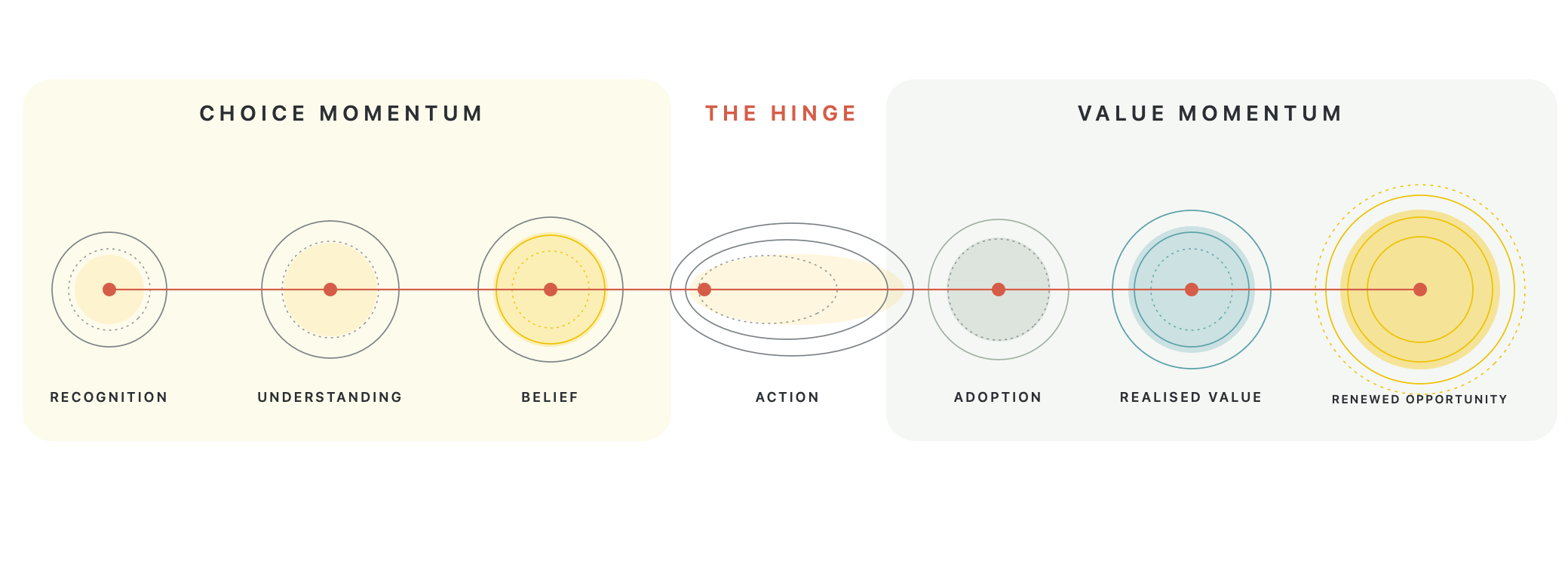
Customer Momentum moves through two connected arcs. Action is the hinge between choosing value and attempting to realise it.
This distinction helps explain why a business can win customers without creating durable growth. Choice Momentum may be strong enough to secure the decision while Value Momentum remains weak. The proposition worked, the sale completed and the implementation began—but adoption stalled before the promised value became real.
The sale is an important commitment. It is not the commercial destination.
04 · READING THE SIGNALS
Businesses naturally look for evidence that their work is producing a response. Traffic grows. Content is opened. Meetings are booked. Demonstrations take place. Pilots begin. Product usage increases.
Each signal may matter. None automatically proves meaningful forward movement.
Attention shows that someone noticed.
Recognition shows that they connected the product to something that matters in their own world.
Commitment becomes visible when they invest something of consequence: time, influence, access, data, budget, resources, reputation or a defined next step.
Value becomes visible when the product is adopted and produces a credible outcome or improvement.
Momentum compounds when that value continues and spreads through deeper use, additional teams, renewal, expansion, advocacy or innovation.
The useful question is not only, “What happened?”
It is, “What changed—and what does that change make possible next?”
Reading momentum means looking at its direction, strength, breadth and continuity. Is movement advancing or slowing? Is belief genuinely supported? Is commitment spreading across the people required? Is value continuing—or was the apparent progress a single, isolated event?
Measurement becomes more commercially useful when it helps the organisation understand how customers are moving, rather than simply counting the volume of activity around them.
Activity is not automatically momentum.
05 · INSIDE THE ORGANISATION
The organisation has to move too.
Customer Momentum is not created by the customer alone.
The organisation behind the product must be able to communicate, sell, deliver and reinforce the value it is asking customers to believe in.
Marketing may create recognition around one expression of value. Sales may reshape that value to move a live opportunity forward. Product may prioritise the capability from a different perspective. Customer success may inherit a promise that is difficult to connect to adoption or realised outcomes.
None of those teams is necessarily wrong. The risk is that the commercial truth changes each time the customer crosses an organisational boundary.
The customer then has to reconstruct the meaning of the product at every stage: from campaign to demonstration, from sale to onboarding, and from onboarding to everyday use.
This is why Whiteboardit considers two audiences at the same time: the customer whose understanding, belief and behaviour need to change, and the organisation that must align its decisions around the value it intends to create.
Internal alignment does not mean every team repeating the same approved sentence. It means each team making decisions from a shared understanding of the customer, the promised change and the evidence that will show whether value is becoming real.
The organisation cannot sustain a Customer Momentum it is not organised to support.
06 · THE DESTINATION
Begin with the movement the business needs.
If understanding is treated as the destination, the natural question is: “How can we explain the product more clearly?”
If Customer Momentum is the destination, the question becomes more demanding:
“What meaningful movement do we need—and what is preventing it?”
The business may need a new buying group to recognise the product’s relevance. It may need belief to spread beyond one internal champion. It may need customers to progress from interest to serious evaluation, from purchase to adoption, or from initial value to deeper use.
Once that movement is clear, we can work backwards.
→ What must customers recognise?
→ What must they understand?
→ What must they believe?
→ What would give them sufficient confidence to commit?
→ What action would represent meaningful progress?
→ What must happen after that action for value to become real and continue?
→ And what must change inside the organisation to support the same movement?
Only then does it become possible to choose the right intervention. The answer may involve positioning, customer research, proof, enablement, launch planning, adoption strategy or product experience. It may also expose a deeper gap in the organisation’s understanding, alignment or ability to deliver the value it promises.
The output follows the movement required. It does not define it.
Customer Momentum changes the purpose of Product Marketing. The work is not complete when customers can explain the product. Nor is it complete when activity creates attention or a sale records a decision.
The work creates a connected path from recognition to commitment, and from commitment to realised value.
Understanding opens that path.
Momentum is what happens when customers begin to travel through it.
A USEFUL PLACE TO BEGIN
Before asking whether customers understand the product, ask what that understanding is enabling them to do next.
If customers recognise the value but remain still—or if they act without going on to realise that value—the break in Customer Momentum may be the right place to look.

CONTINUE EXPLORING