
WHITEBOARDIT THINKING · 001
The Translation Gap: why strong products lose momentum.
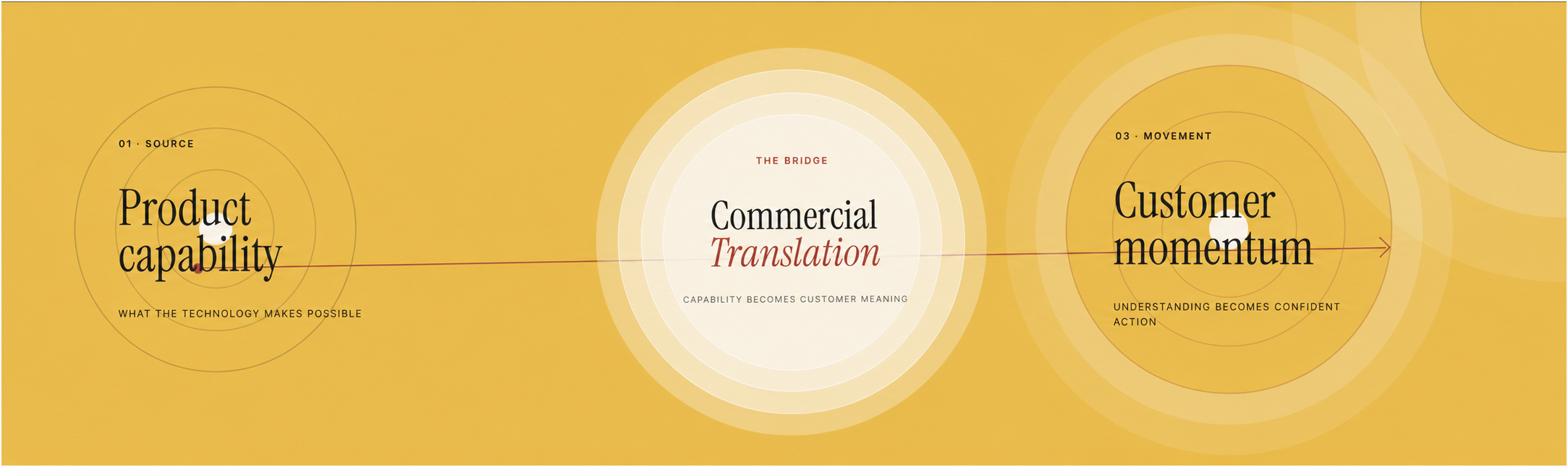
The distance between product capability and customer action is rarely closed by more messaging. It is closed by finding the full value, making it meaningful and helping the organisation move around a shared truth.
BY SHARON WHITE
28 JULY 2026 · 8 MIN READ
Some of the strongest products are surprisingly difficult to move through a market. The capability is real. The engineering is thoughtful. Customers may even agree that the problem matters. Yet the commercial response remains slower, flatter or less confident than the product deserves.
When that happens, businesses often reach first for more activity: more messaging, more content, a louder launch or another campaign. Sometimes those things help. But they cannot repair a gap that sits deeper than communication.
I think of that deeper space as the Translation Gap: the distance between what a product is capable of and what another human being can understand, value, believe and act on.
01 · THE INVISIBLE GAP
A product can be strong and still be commercially hard to move.
Inside a technology business, a product is experienced through its architecture, roadmap, feature set and the effort required to build it. Teams know its history. They understand why a particular capability was difficult to create and why it represents progress.
Customers meet something different. They meet a decision. They are trying to work out whether this product belongs in their world, whether the change it promises is worth the effort and whether acting now feels safer than staying where they are.
The Translation Gap opens when an organisation communicates from the first experience while the customer is deciding from the second. It often appears as a messaging problem, a launch problem or an adoption problem. Those are the symptoms. The underlying issue is that product capability has not yet become customer meaning.
The market does not experience the effort behind the product. It experiences the meaning the product creates in a customer’s world.
02 · WHITEBOARDIT FOUNDATIONS
Start beneath the message: find the foundations of value.
Before deciding how to describe a product, it is worth becoming much clearer about the value available to describe. That means looking beyond the headline use case or the segment that happens to be loudest internally.
Three forms of truth need to be held together:
Product truth
What the technology genuinely makes possible—not simply what it does.
Customer truth
The situations, pressures, use cases and outcomes that make that possibility valuable.
Market truth
The alternatives, expectations and conditions shaping whether the customer will move.
Value becomes visible in the relationship between these truths. A single capability may create different value for different users, buying groups or moments. One customer may care about speed; another about confidence, resilience, control or the removal of risk. If we settle too quickly on one expression of value, we can leave important commercial territory undiscovered.
This is why customer understanding is not a preliminary research task to complete and move past. It is part of the commercial infrastructure of the product. It tells us which value matters, to whom, in which context—and what may prevent that value from being believed.
03 · WHITEBOARDIT THINKING
Commercial Translation is the bridge—not the final coat of language.
Translation can sound like simplification: take something technical and make it easier to read. But that is too small. Complex products do not need to be made less intelligent. They need to be made meaningful from the vantage point of the person being asked to act.
Commercial Translation connects product truth to customer truth in the context of the market. It reveals the change inside the capability and gives people a coherent reason to believe that change is relevant to them.
A useful translation helps a customer answer three questions:
01
Do I recognise myself?
Is this grounded in a situation, pressure or ambition I genuinely experience?
02
Do I believe the change?
Can I connect the product’s capability to an outcome that feels credible and valuable?
03
Do I know how to move?
Is the next decision clear enough—and safe enough—to take?
Messaging contributes to those answers, but it is not the whole answer. Positioning, product experience, proof, sales conversations, launch choices and adoption all carry part of the translation. The commercial story is not just what the business says. It is the shared logic behind how the business goes to market.
04 · INSIDE THE ORGANISATION
The customer cannot receive a clarity the organisation does not share.
Translation has an internal journey before it has an external one. Product may frame value through capability. Sales may frame it through live deal pressure. Marketing may frame it through audience and attention. Leadership may frame it through growth and strategic priority.
None of those views is inherently wrong. The risk is that they remain separate. When teams build from different versions of the truth, the customer receives fragments: a campaign that promises one thing, a product conversation that emphasises another and a sales story that has been rewritten to survive the meeting.
Alignment is not everyone repeating the same approved sentence. It is people making decisions from the same understanding of the customer, the value and the commercial priority. Once that shared foundation exists, teams can adapt their expression without losing the thread.
05 · THE WHITEBOARDIT METHOD
Listen. Translate. Align. Activate.
Closing the Translation Gap is not a single workshop or messaging exercise. It is a practical movement from understanding to use. The Whiteboardit Method holds that movement in four connected disciplines:
01
Listen
Notice what customers say, what teams assume, where language diverges and which value remains hidden inside different use cases.
02
Translate
Connect technical capability to the human and commercial change it can create, without sanding away the depth that makes it distinctive.
03
Align
Bring product, marketing, sales and leadership around the choices that matter so the organisation can carry one coherent truth.
04
Activate
Put the thinking to work across the real customer journey—from positioning and launch to sales confidence, adoption and growth.
The order matters, but the method is not linear. Activation creates new evidence. Customer response sharpens the listening. The translation evolves. Alignment is renewed. The work creates a learning loop rather than a static answer.
06 · THE DESTINATION
Momentum is a chain of small convictions.
A market rarely moves because of one dramatic message. People move through a series of smaller convictions. They understand. That understanding creates confidence. Confidence creates intent. Intent makes action possible. Useful action becomes momentum.
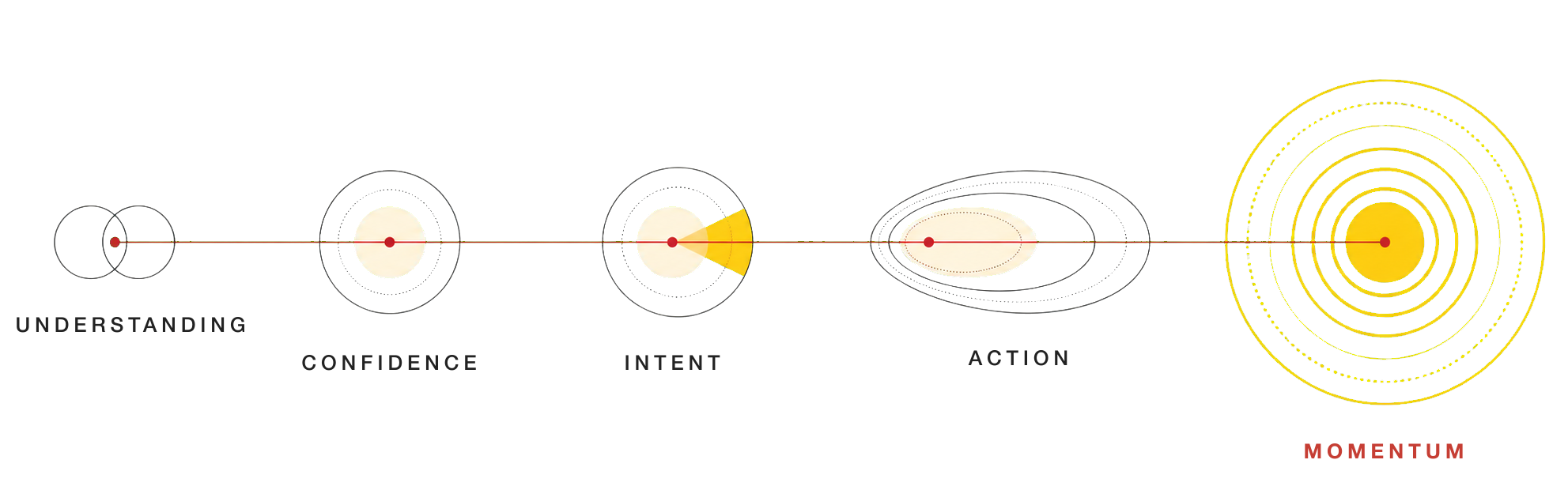
This changes the question a business asks. Instead of asking only, “How do we make more noise about the product?”, we can ask: “Where is belief breaking down—and what truth, proof, experience or alignment would help the next conviction form?”
That is a more demanding question. It is also a more useful one. Because strong products do not need empty volume around them. They need the full value inside them to become visible, credible and ready to move through the world.
A USEFUL PLACE TO BEGIN
Before asking how to say it louder, ask where the meaning was lost.
If your product has real capability but its commercial story, launch or adoption is not moving with it, the Translation Gap may be the right place to look.
CONTINUE EXPLORING